Back to top
Copper Chloride (134.45 g/mol)

Copper Chloride (134.45 g/mol)

Price 435.0 INR/ Kilograms

MOQ : 1 Kilograms

Copper Chloride (134.45 g/mol) Specification

  • Application
  • Industrial
  • Refractive Rate
  • 1.75
  • Purity
  • 98 99%
  • Molecular Formula
  • NA
  • Physical Form
  • Solid
  • CAS No
  • NA
  • Usage
  • Catalyst in organic synthesis; pigment; electroplating; laboratory reagent
  • Structural Formula
  • NA
  • Melting Point
  • 498 C
  • Appearance
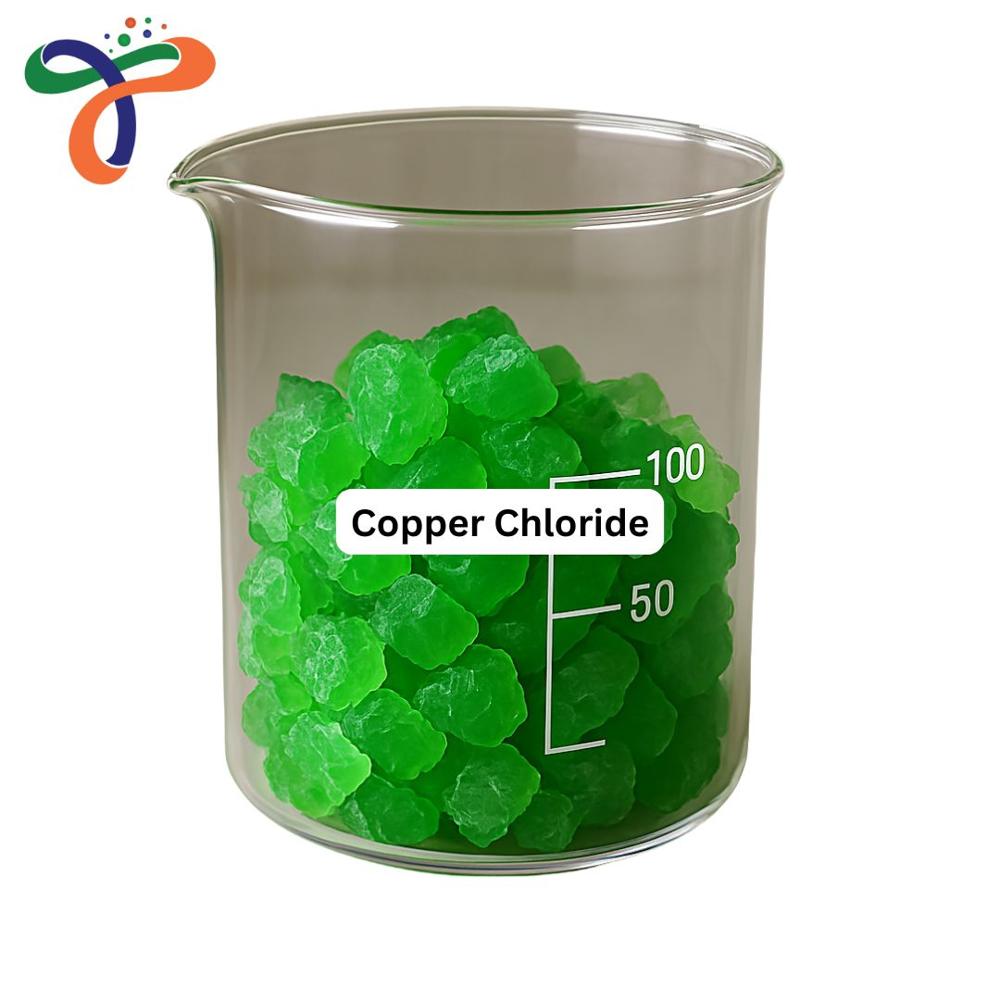
  • Blue-green crystalline solid
  • Properties
  • Copper chloride is a versatile yellowish-brown or blue-green solid primarily used as a catalyst in organic synthesis and petroleum refining. It is essential in textile dyeing as a mordant, in the manufacture of pyrotechnics to produce green flames, and as an agricultural fungicide.
  • Solubility
  • Soluble in water; forms blue solutions
  • Molecular Weight
  • 134.45 g/mol Grams (g)
 

Copper Chloride (134.45 g/mol) Trade Information

  • Minimum Order Quantity
  • 1 Kilograms
  • Payment Terms
  • Cash in Advance (CID)
  • Supply Ability
  • 5000 Kilograms Per Month
  • Delivery Time
  • 10 Days
  • Main Domestic Market
  • All India
 

About Copper Chloride (134.45 g/mol)

We are Supplier, Exporter and Contract Manufacturer.
Technical profile of Copper Chloride, a high-purity raw chemical material supplied by Triveni Chemicals for industrial manufacturing and laboratory synthesis.

Industrial Uses & Applications:
Copper Chloride Is An Inorganic Copper Salt Widely Used In Industrial, Chemical, And Laboratory Applications. It Is Commonly Applied As A Catalyst In Organic Synthesis, Oxidation Reactions, And Chlorination Processes. The Compound Is Also Used In Pigments, Wood Preservation, Metal Etching, And As A Source Of Copper In Electroplating And Chemical Manufacturing.


Key Features and Benefits

Copper chloride's high solubility and refractive rate (1.75) enhance its effectiveness as a catalyst in multiple industrial applications. Its vivid blue-green hue benefits textile dyeing, while its role in pyrotechnics adds visual appeal to firework displays. As an agricultural fungicide, it helps protect crops, contributing to increased yields and quality. Its versatility and reliability make it a favored industrial reagent.


Diverse Industrial Applications

Employed in the manufacture of pigments and as a catalyst, copper chloride is integral to processes in organic synthesis and petroleum refining. It also finds crucial use in laboratory experiments, electroplating metals, and generating green-colored flames in fireworks. In textiles, copper chloride acts as a mordant, helping to fix dyes for vibrant, lasting colors.

FAQ's of Copper Chloride (134.45 g/mol):


Q: How is copper chloride typically used in industrial applications?

A: Copper chloride serves predominantly as a catalyst in organic chemical synthesis and petroleum refining, accelerating reactions to increase process efficiency. It is also utilized in pigment production, electroplating, and as a laboratory reagent due to its reactivity and solubility.

Q: What benefits does copper chloride offer in textile dyeing?

A: As a mordant, copper chloride helps fix dyes to textiles, enhancing color strength and permanence. Its distinctive properties ensure that dyed fabrics maintain vibrant, lasting shades, making it indispensable in textile manufacturing.

Q: When is copper chloride used in pyrotechnics, and why?

A: Copper chloride is employed during the manufacturing of pyrotechnic compositions to produce bright green flames. Its unique chemical characteristics are optimized at high temperatures, intensifying the color display in fireworks and signal flares.

Q: Where can copper chloride be applied in agriculture?

A: In agriculture, copper chloride is mainly used as a fungicide to protect crops from fungal diseases. Its application helps control various infections, safeguarding crop health and improving overall agricultural productivity.

Q: What is the process for preparing a copper chloride solution for laboratory use?

A: To prepare a copper chloride solution, the solid salt is dissolved in distilled water until fully integrated, resulting in a blue solution. This process takes advantage of copper chloride's excellent water solubility, ensuring even distribution for experimental procedures.

Q: How does the high purity (98-99%) of copper chloride benefit industrial users?

A: High-purity copper chloride ensures consistent, reliable performance in industrial processes, reducing impurities that might interfere with reactions or final product quality. This makes it particularly valuable for catalytic applications and laboratory work where precision is essential.

Tell us about your requirement
product

Price:

Quantity
Select Unit

  • 50
  • 100
  • 200
  • 250
  • 500
  • 1000+
Additional detail
Mobile number

Email

More Products in Industrial Chemicals Category

Palmitoyl Chloride (112-67-4)

Palmitoyl Chloride (112-67-4)

Price 620.0 INR / Kilograms

Minimum Order Quantity : 25 Kilograms

Melting Point : 4 C

Appearance : Colorless liquid

Solubility : Practically insoluble in water; soluble in organic solvents such as dichloromethane, chloroform, and diethyl ether

Properties : Palmitoyl Chloride is a moisture sensitive, corrosive acyl chloride that reacts vigorously with water to release HCl. Widely used as an intermediate in organic synthesis, it plays a key role in producing surfactants, pharmaceuticals, and polymers.

Octyltriethoxysilane (2943-75-1) (C14H32O3Si)

Octyltriethoxysilane (2943-75-1) (C14H32O3Si)

Price 275.0 INR / Kilograms

Minimum Order Quantity : 25 Kilograms

Melting Point : 60 C

Appearance : Clear, colorless liquid

Solubility : Soluble in organic solvents; immiscible with water

Properties : Octyltriethoxysilane is a versatile organosilane coupling agent primarily used to provide excellent hydrophobicity to mineral surfaces. By creating a crosslinked siloxane film, it is essential in protecting concrete and stone from water intrusion. It is also used as a surface modifier to improve the dispersion of fillers in polymers.

Tetrabutylammonium Fluoride Trihydrate

Tetrabutylammonium Fluoride Trihydrate

Price 8000.0 INR / Kilograms

Minimum Order Quantity : 25 Kilograms

Melting Point : 68 C

Appearance : White crystalline solid

Solubility : Soluble in water and polar solvents; insoluble in nonpolar solvents

Properties : Tetrabutylammonium fluoride trihydrate is a widely used fluoride source in organic synthesis. It is particularly valued for its ability to desilylate silyl ethers, acting as a crucial tool for removing protecting groups. Its hydrate form is easier to handle and more stable than the highly hygroscopic anhydrous version.

4-Chloro-2-Nitroaniline (C6H5ClN2O2) (172.57 g/mol)

4-Chloro-2-Nitroaniline (C6H5ClN2O2) (172.57 g/mol)

Price 640.0 INR / Kilograms

Minimum Order Quantity : 25 Kilograms

Melting Point : 62 C

Appearance : Yellow crystalline solid

Solubility : Slightly soluble in water; soluble in ethanol and acetone

Properties : 4Chloro2nitroaniline is a bright yellow aromatic intermediate primarily used in the synthesis of organic pigments and dyes. It serves as a key diazo component for manufacturing highperformance azo pigments, such as Pigment Yellow 3, widely utilized in industrial coatings, printing inks, and plastic colorants.