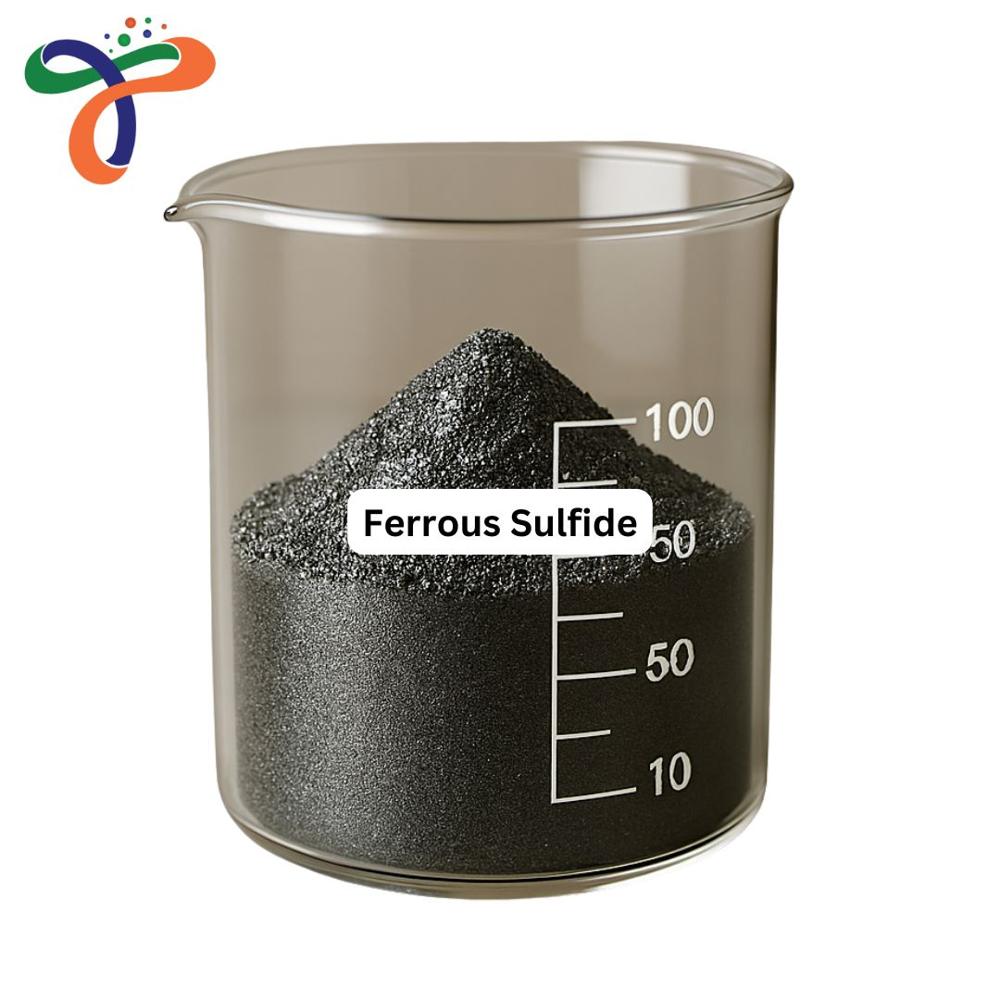
Ferrous Sulfide (1317-37-9) About
We are Supplier, Exporter and Contract Manufacturer.
Technical profile of Ferrous Sulfide, a high-purity raw chemical material supplied by Triveni Chemicals for industrial manufacturing and laboratory synthesis.
Technical Specifications:
CAS Number: 1317-37-9
Industrial Uses & Applications:
Ferrous Sulfide Is An Inorganic Iron Sulfide Compound Commonly Used In Laboratory And Industrial Applications. It Is Valued For Its Reactivity With Acids, Producing Hydrogen Sulfide Gas, Which Makes It Useful In Qualitative Chemical Analysis. Ferrous Sulfide Is Commonly Used In Laboratories For Gas Generation Experiments And In Metallurgical Processes As An Intermediate. It Also Finds Application In Chemical Synthesis And Research.
Key Applications in IndustryFerrous sulfide is integral to multiple industrial processes, serving as a laboratory reagent to generate hydrogen sulfide gas, a precursor in pigment formation, and a refining agent in ore processing. Its chemical stability and unique semiconducting properties further its utility in ceramics, lubricants, and high-performance battery technology.
Distinct Physical and Chemical PropertiesExhibiting a metallic sheen, ferrous sulfide appears as a dense, black powder. Its insolubility in water, high melting point of 1114C, and rapid reaction with acids to form hydrogen sulfide are central to its role in both laboratory and industrial contexts. Its high purity (98-99%) enables consistent results across applications.
FAQ's of Ferrous Sulfide (1317-37-9):
Q: How is ferrous sulfide commonly used in laboratory settings?
A: Ferrous sulfide is primarily utilized in laboratories as a reagent to generate hydrogen sulfide gas for chemical synthesis and analytical experiments. The reaction is often triggered by adding acids to ferrous sulfide powder.
Q: What benefits does ferrous sulfide offer in industrial applications?
A: Its high purity and reactivity make ferrous sulfide ideal for creating specialized alloys, lubricants, and ceramics. It also serves as a precursor in pigment manufacturing and as a semiconductor component in lithium-ion battery research.
Q: When should precautions be taken during the handling of ferrous sulfide?
A: Precautions are necessary when ferrous sulfide is exposed to acids, as it releases hazardous hydrogen sulfide gas. Proper ventilation and protective equipment should be used during handling and storage.
Q: Where is ferrous sulfide most frequently sourced and supplied?
A: Ferrous sulfide is typically manufactured and supplied by chemical companies in India and is widely distributed to laboratories and industrial sectors around the globe.
Q: What is the process for generating hydrogen sulfide gas from ferrous sulfide?
A: Hydrogen sulfide gas is produced by reacting ferrous sulfide powder with a suitable acid (commonly hydrochloric acid) in a controlled laboratory apparatus, liberating the gas for further use.
Q: How does the insolubility of ferrous sulfide in water impact its usage?
A: Being insoluble in water, ferrous sulfide maintains stability during storage and handling and is easy to separate from aqueous mediums, making it suitable for specific chemical processes involving non-aqueous reactions.










 Send Inquiry
 Send Inquiry
 Send Inquiry
 English
 Spanish
 French
 German
 Italian
 Chinese (Simplified)
 Japanese
 Korean
 Arabic
 Portuguese